
Chapter 4 - The Descent
From "The One Who Walks Forward" by Alex Blumberch

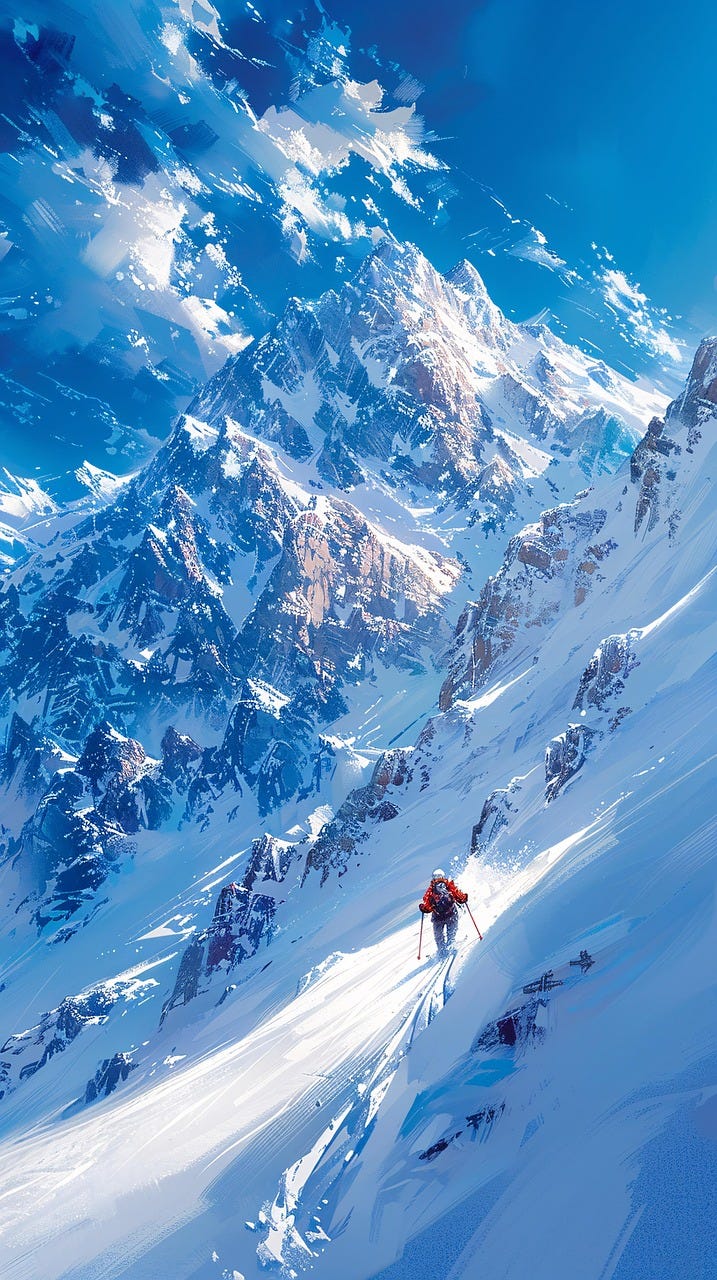
People think the descent is easy. That once you reach the summit, the rest is simple —just walking down. But you know better. The path downward is just as steep as the climb, just as narrow, just as unforgiving.
Your steps are careful now. Measured. You test the ground before you shift your weight.
It surprises you, how quickly the old fears try to return.What if you fall? What if you slip? What if the man you became at the summit can’t survive the valley below? You breathe through it. Not to silence the fear — but to steady the footing. Because becoming someone new at the top of the mountain means nothing if you cannot carry him down.
The moment you begin your descent, you notice something strange.
The world is quieter. Not empty. Not hollow. Just… still.
The noise that used to press against your mind like a constant storm has faded. Your senses sharpen instead of overwhelm. Colors look richer, edges softer, the wind more articulate. It isn’t the world that has changed.
It’s the man walking through it.
They are fewer than you remember. Or maybe you simply see less of what you once mistook for connection. The figures that used to fill your mind and drain your energy no longer stand out. Most of them fade into the background — not because you don’t care, but because they were never meant to be central to your path.
But here and there, you notice one or two — moving with a rhythm that matches your own.Their presence doesn’t pull you or drain you. It aligns you.They are not mirrors. They are companions in resonance. And without speaking, you know: this is the frequency you walk at now.
When you descend from the summit, the first thing you do is not profound. It is not spiritual. It is not dramatic. It is simple: you pick up an axe. Your hands close around the handle with a familiarity that feels older than this lifetime. A lineage move. A masculine rite.
The wood waits. The cold air stings. Your breath clouds in front of you and then disappears.You lift the axe. Not with anger. Not with force. But with presence.The strike lands clean. The log splits. The world opens a fraction.
You work—not to prove, but to tend.
This is what the masculine looks like when it returns home from a mountain: quiet competence. Steady motion. Doing the next necessary thing without fanfare.
When the fire catches, it does so with the same slow certainty you feel spreading through your chest.No rush. No flare. Just a deepening warmth that builds one ember at a time. You sit with it. You watch it. You let it teach you something about pace.
Only after the fire settles do you put the kettle on.Tea is your reminder that not everything must be climbed. Some things must be held.The cup warms your fingers. The steam rises like a blessing. And for the first time since the descent began, your body realizes it is safe.
When you walk into the world again, the first thing people notice is not your eyes or your shoulders or your silence. It’s your steadiness.
There’s a new gravity in you, a way your presence settles into a room instead of ricocheting around it. You used to flicker — too much energy, too many thoughts, too many wounds trying to speak at once. But now you are quiet in a way that calms the air.
Some people don’t know what to do with that. They were used to your edges. Your urgency. Your vulnerability.When you no longer dance around their moods or collapse under their emotions, they pull back. Not out of malice — out of misalignment.
But others… the ones who vibrate where you vibrate now… they soften.They speak slower, look longer, breathe deeper around you. Your steadiness invites theirs. Women especially feel the shift. Not romantically — energetically.
The nervous feminine, the overwhelmed feminine, the guarded feminine… relaxes a fraction when you enter the space. Not because you save them but because you don’t lean on them. You are a presence, not a pull.
Men react too. Some straighten. Some shrink. Some nod to you subtly, recognizing something ancient — the weight of someone who has faced himself and survived.You don’t try to be seen. You don’t perform steadiness. You inhabit it. And the world responds not to your achievements but to your frequency.
The valley greets you gently. Not with thunder or revelation — but with a feeling you cannot quite name.
Anticipation, yes. Unease, yes. A loneliness that stings just enough to remind you that you descended alone. And beneath it all — a quiet excitement you’re almost afraid to acknowledge.
It looks empty at first glance. Wide. Open. Unmapped.But the emptiness is an illusion.This is the place where your next purpose forms itself, grain by grain, step by step,breath by breath.
The mountain demanded your strength. The climb demanded your will. But the valley demands something harder: your patience.You don’t know what comes next. You don’t know what path you’re meant to follow.You don’t know what the next ascent will ask of you.
And that is the unease.
There is a loneliness in standing at the bottom again. A tenderness, really. Because after becoming someone at the summit, you expect the world to greet you differently.
But the valley is quiet. It waits. It watches. It does not rush your next becoming.
This is the excitement you don’t want to say out loud: you feel the next mountain.
You can’t see it yet. But something in your ribs knows.
Something is coming. Something large. Something that requires the man you became on the first ascent.
The valley isn’t the rest after the climb. It is the test of the climb. A place where purpose approaches slowly, like a distant sound you hear long before you understand it. A place where you don’t crumble, you don’t sprint, you don’t collapse —you wait. Not passively. Not helplessly.
But with anticipation sharpened by unease, loneliness softened by excitement, and readiness forged on the summit.
I am releasing a chapter every week. If you are still reading this - thank you.
— Alex Blumberch/Threadwalker
©2025 All rights reserved. No part of this publication may be reproduced, stored or transmitted in any form or by any means, electronic, mechanical, photocopying, recording, scanning, or otherwise without written permission from the publisher. It is illegal to copy this book, post it to a website, or distribute it by any other means without permission.